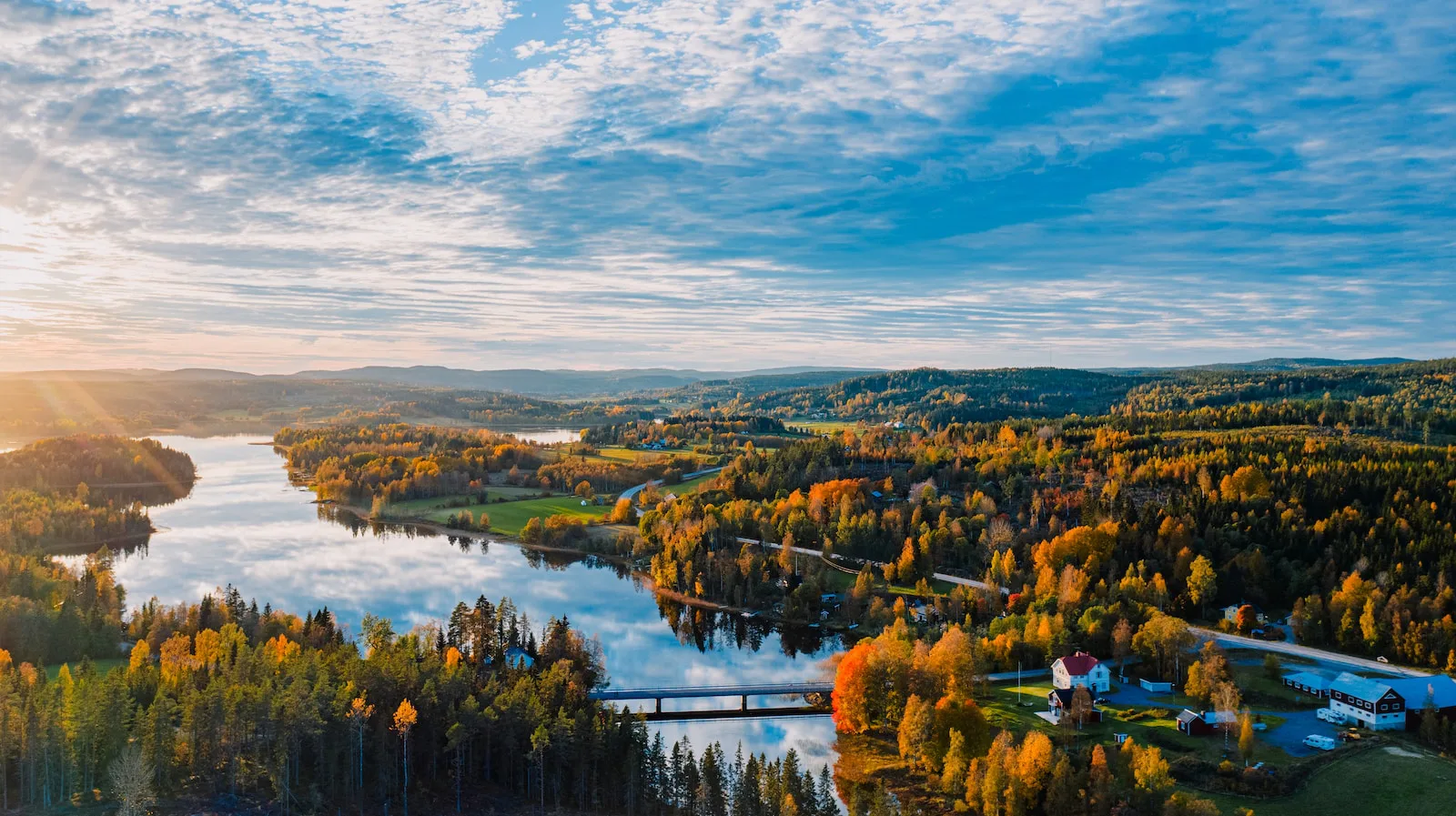
Sweden is long, thinly settled and expensive, and the trip works best when you accept all three. About 10.6 million people live on a strip that runs from Malmö’s beaches to Kebnekaise at 2,096.8 m, with 31 national parks in between. Pick one region and give it a week: a Stockholm city break with the archipelago, a west-coast summer around Gothenburg, or a winter in Swedish Lapland for the northern lights.
Regions and main cities
The tourist board splits the country into three parts: north, middle and south.
The north is Swedish Lapland, above the Arctic Circle. Kiruna is the base: an iron mine you can tour, a town that is being moved to escape it, and the Icehotel in nearby Jukkasjärvi. The sun does not set here for around 47 days each summer and does not rise for 27 days in midwinter.
The middle holds the capital. Stockholm spreads across islands, with the Vasa warship, Skansen and Gamla Stan close together and Drottningholm Palace a boat ride away. Uppsala, with its cathedral and old university, is an easy day out. Further inland, Örebro has a moated castle and the wooden quarter of Wadköping, and Linköping pairs a cathedral with an open-air old town and two canals.
The south is where Sweden meets Denmark and the sea. Gothenburg has Liseberg, Universeum and a car-free archipelago on the tram network. Malmö sits at the Swedish end of the bridge to Copenhagen, with the university town of Lund next door and Helsingborg and its Denmark ferry up the coast. Out in the Baltic, Visby on Gotland keeps a complete medieval ring wall.
Getting there and around
Most visitors land at Stockholm Arlanda, which handled 22.7 million passengers in 2024, or Göteborg Landvetter with 5.3 million. Between cities you have trains, coaches and, from Denmark, the bridge or ferry; the transport guide covers tickets and day passes.
If you drive, winter tyres are compulsory in winter conditions from 1 December to 31 March, and studded tyres are allowed from 1 October to 15 April. Stockholm and Gothenburg charge a congestion tax that also applies to foreign-registered cars, billed afterwards through EPASS24. The drink-driving limit is 0.2 per mille.
When to go
The climate runs in bands. Stockholm’s July normal is 18.7 °C against -1.0 °C in January; Kiruna manages 13.2 °C in July and sits at -11.3 °C in January. June to August is the season for the coast, the archipelagos and camping under the right of public access, which lets you pitch a tent for one or two nights out of sight of houses. Midsummer, Walpurgis on 30 April and National Day on 6 June are the dates locals plan around. For the aurora, go north between late autumn and March, and dress for the Kiruna numbers above. The climate guide has month-by-month detail.
Money, safety and visas
Sweden is close to cashless. Only 5 per cent of Swedes paid their last shop purchase in cash in 2025, and one in three companies surveyed do not take it; the Riksbank says cash is rarely used. Alcoholic drinks are sold only through the state-owned Systembolaget, where you must be 20. Prices and daily budgets are in the cost guide.
The emergency number is 112; 1177 is the non-urgent healthcare line. The main risks are ordinary ones: pickpockets where crowds gather, a UK advisory that terrorist attacks are likely, and ticks. There are no vaccination requirements, but the health agency recommends a TBE jab for anyone at risk of tick bites in Risk Zone 1. EU visitors with an EHIC pay local patient fees; most others pay in full, so carry insurance. More in the safety guide and the health guide.
EU and EEA citizens need no permit. British and American passport holders get 90 days in any 180 visa-free (US: Annex II), and since 10 April 2026 the EU’s Entry/Exit System records fingerprints and a photo at the border; ETIAS pre-authorisation is due in the last quarter of 2026. Anyone who needs a Schengen visa must show SEK 700 per day of funds and pays a EUR 90 fee. Details by passport are in the visa guide.